
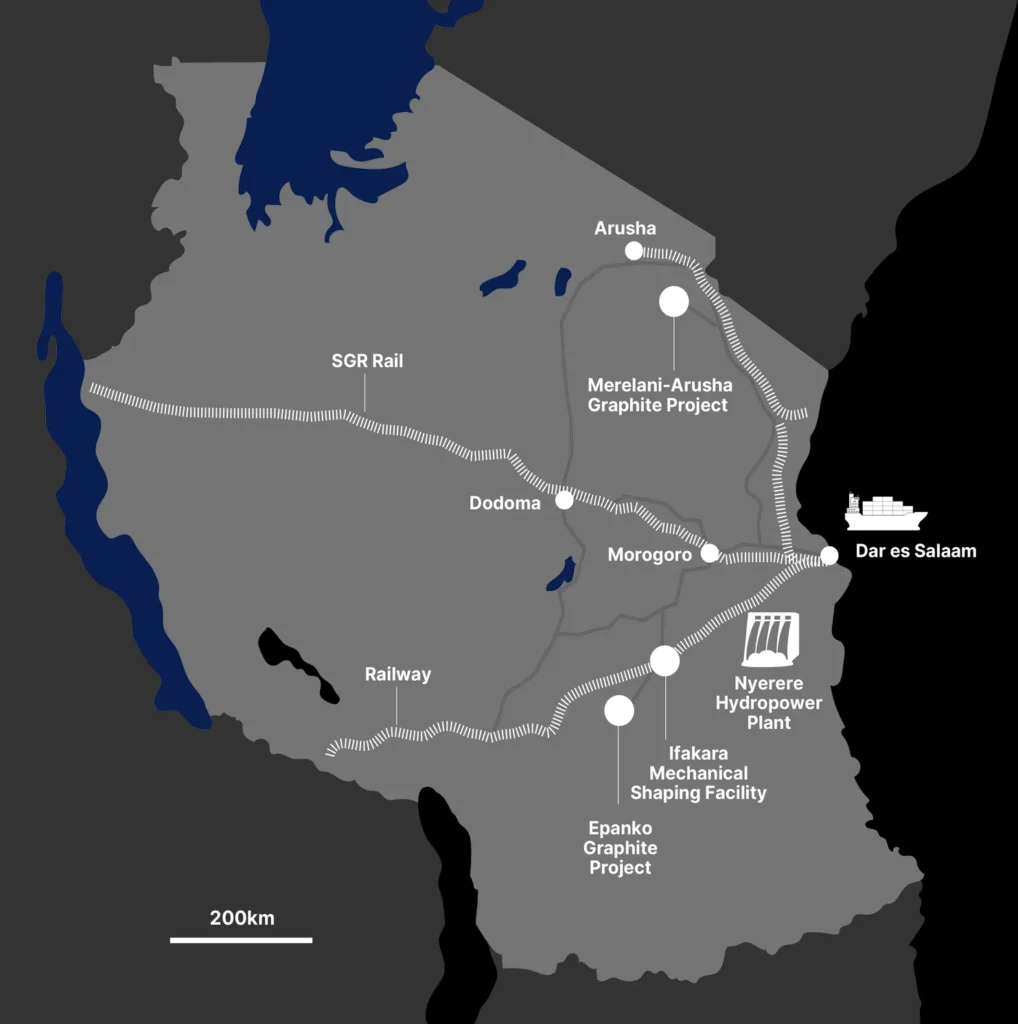
Australian-listed EcoGraf Ltd has released new technical and economic assessments confirming that its Epanko natural flake graphite project in Tanzania holds significant potential for large-scale, staged production expansion. As global demand for natural graphite intensifies—especially for lithium-ion battery anodes—Epanko is increasingly viewed as a strategically important resource base in the global supply chain.
Clear Expansion Path: From 73,000 tpa to 390,000 tpa
EcoGraf has adopted a staged expansion strategy, allowing the project to scale in line with market demand while maintaining manageable capital intensity.
The proposed development path includes:
Phase 1 capacity: 73,000 tonnes per year,
backed by a confirmed US$160 million senior debt facility from Germany’s KfW IPEX-Bank.
Long-term expansion to ~390,000 tonnes per year
through multiple construction stages that add new flotation, purification, and downstream processing modules over a 10-year period.
EcoGraf also reported promising findings from a newly identified 2-km southern extension zone, where early samples indicate high-grade mineralization—suggesting additional resource upside that could support further growth.
Africa’s Role in the Global Graphite Map Continues to Rise
Natural graphite—representing about 30% of a lithium-ion battery’s material mass—has long been dominated by Chinese supply. However, recent supply chain diversification policies in Europe, the United States, Japan and India have dramatically increased demand for non-Chinese natural graphite sources.
In this context, African deposits—particularly in Tanzania, Mozambique and Madagascar—are becoming pivotal.
The Epanko project is expected to contribute to:
- Strengthening Africa’s position in the global anode materials supply chain
- Reducing geopolitical dependence in critical mineral supply
- Supporting regional development of midstream processing capacity, such as purification and shaping operations
With long mine life, favorable geology and strong institutional backing, Epanko is poised to become one of the continent’s most influential graphite hubs.
The True Challenge Lies in “From Ore to Anode-Ready Material”
While resource volume and grade are important, the real bottleneck for natural graphite projects is whether they can establish a stable, energy-efficient and scalable processing chain capable of producing battery-grade material.
Natural graphite must undergo several precision-controlled steps before it can be used in anodes, including:
crushing, flotation, spheroidization, shaping, purification, coating (granulation), high-temperature carbonization, magnetic separation, sieving, and final packaging.
Each stage directly affects:
- Particle-size distribution (D10/D50/D90)
- Tap density
- Impurity concentration (Fe, Si, Cu, etc.)
- Oil absorption value
- Cycle life and batch-to-batch consistency
Therefore, the long-term competitiveness of a graphite mine depends not only on its resource but on its ability to execute these processes consistently and efficiently.
Outlook: A Potential Pillar in Future Global Supply Chains
As EV adoption accelerates and grid-scale energy storage grows, the demand for natural graphite continues to outpace earlier forecasts. Combined with geopolitical pressure to diversify upstream sources, Epanko’s staged expansion aligns well with global supply needs.
If construction proceeds as scheduled, Phase 1 production could supply the market within the next few years—positioning Epanko as a major contributor to global battery-grade natural graphite supply and one of the world’s most significant flake graphite production centers by the next decade.
From our experience supporting graphite-anode projects worldwide, we observe that large natural graphite mines often face challenges during process verification and scale-up.
Our team provides pilot-line validation and full-process technical reference—covering spheroidization, shaping, purification, coating, and high-temperature carbonization—to help clients evaluate feasibility before committing to large-scale investment.