
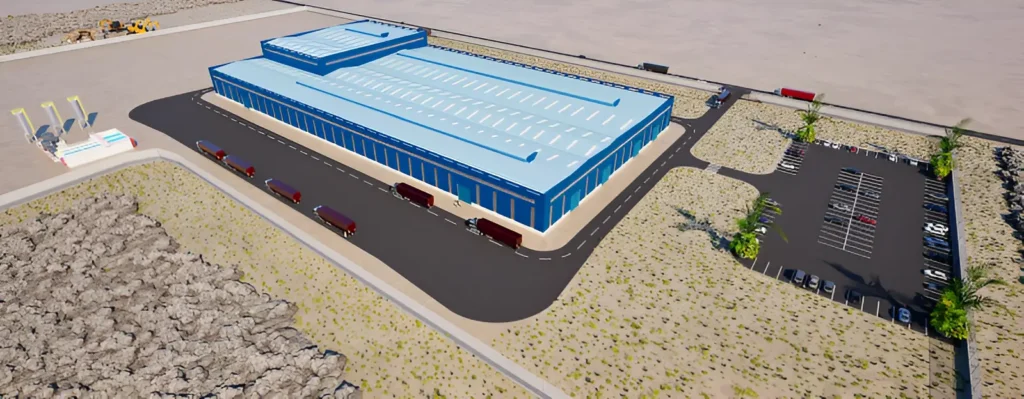
Abu Dhabi-based Falcon Energy Materials plc (TSX-V: FLCN / OTCQB: FLCNF) has announced the results of a technical-economic study (“Technical Study”) for its planned natural graphite spheroidization, purification and coating (CSPG) anode material plant in Morocco. The study, prepared to AACE Class 3 standards by Dorfner Anzaplan UK Limited, confirms a solid economic foundation for the project and Falcon’s vision to become a low-cost, large-scale CSPG producer.
Key Metrics & Project Scope
According to the study:
- Target annual output of 26,000 tonnes of CSPG and 19,000 tonnes of fines.
- Initial capital expenditure (CapEx), including contingency, estimated at approximately US$86 million.
- All-in operating cost projected at US$3,168 per tonne of CSPG.
- First production planned for the second half of 2027, following a 9-month detailed engineering phase and a 15-month construction & commissioning period.
Falcon CEO Matthieu Bos commented, “This Technical Study validates our vision — it confirms that Falcon’s approach is the most credible path to producing high-quality, low-cost CSPG at industrial scale.”
Process Flow & Strategic Location
The plant will be located near Jorf Lasfar in Morocco, covering approximately five hectares and leveraging port infrastructure, a low-carbon grid and existing trade agreements with the US and EU.
The processing route outlined includes:
- Spheroidization: Micronisation of graphite flake, primary and secondary spheroidization to produce spherical graphite categorized as “SG18” (~18 μm) and “SG8” (~8 μm), achieving a yield of ~60%.
- Purification: Raising purity from ~95% to 99.95% using hydrofluoric, hydrochloric and nitric acids; moisture reduced to <1%.
- Coating: Applying an amorphous carbon layer (3–25 nm) on spherical purified graphite (SPG) to produce CSPG; followed by demagnetization, sieving and bagging.
Advanced gas-scrubbing and water-treatment systems are incorporated to meet Moroccan environmental standards.
Market Significance & Downstream Implications
CSPG (Coated Spheronized Purified Graphite) is a critical component in lithium-ion battery anodes, a segment experiencing rapid growth driven by EVs and grid storage. Falcon’s project reflects three broader trends in the industry:
- Vertical advancement from raw ore to battery-grade material manufacturing.
- Geographical diversification, reducing dependency on traditional sources.
- Transparent economics: clearly defined CapEx, operating cost and product pricing (~US$8,300 per tonne for the proposed product mix).
From a supply-chain perspective, projects that can deliver fully processed, high-performance graphite anode material at scale will be in a competitive position.
Industry Insight: Process Engineering & Equipment Are Critical
For natural graphite projects to succeed commercially, the processing chain must be thoroughly optimized — from raw flake to battery-grade material. The key steps include: crushing, flotation, spheroidization, shaping, purification, coating (granulation), high-temperature carbonization, magnetic separation, sieving and packaging.
The economics and technical success of Falcon’s study underscore this fact: equipment performance, process yield, consistency and cost control are decisive. For equipment, engineering and materials suppliers, the takeaway is clear: capability in those key steps is what separates commercial-scale winners from laggards.
Conclusion
Falcon’s anode-plant study provides a meaningful benchmark for the emerging natural graphite anode-material sector. Its relatively modest CapEx, defined operating costs and targeted production schedule make it a telling case of how processed graphite projects are evolving.
For players evaluating the natural-graphite to anode-materials pathway, understanding the process, equipment and scale-up dynamics is essential.
If you are evaluating natural graphite-based anode projects, we provide pilot-line validation and processing-equipment reference across spheroidization, shaping, purification, coating and carbonization.