
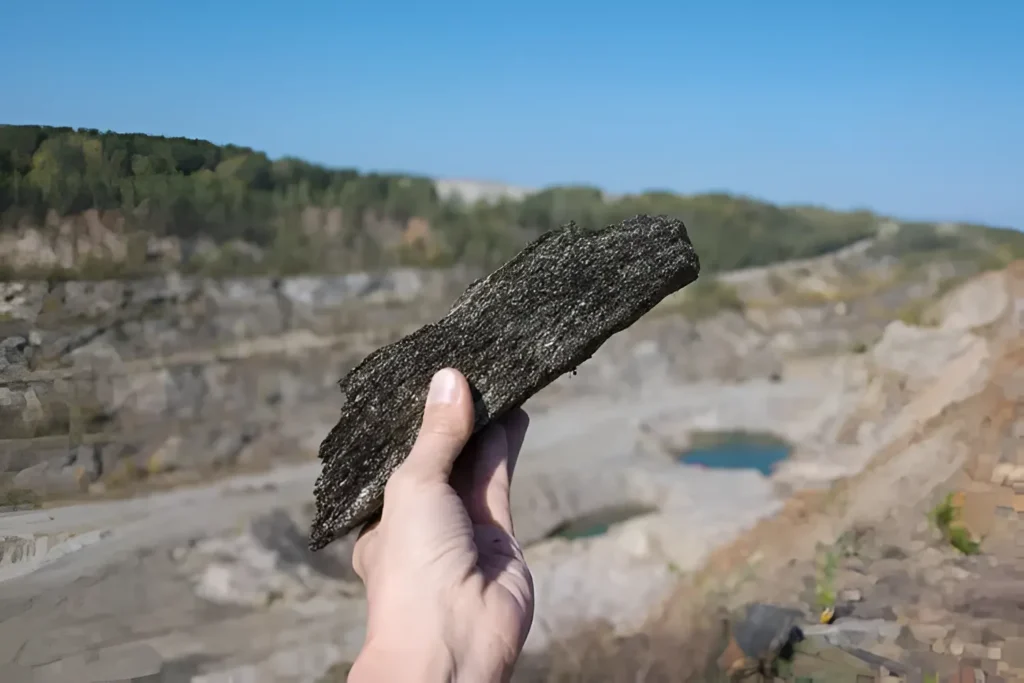
A large-scale flake graphite deposit has recently been identified in La Rioja Province, Argentina, marking a new milestone in the country’s growing role within the global critical minerals landscape.
As one of the minerals officially recognized on Argentina’s Critical Minerals list, graphite is essential to the production of lithium-ion battery anodes and a cornerstone material in the global clean-energy transition.
The Strategic Value of Flake Graphite
Graphite remains the dominant raw material used in lithium-ion battery anodes, accounting for 95–99 % of the anode composition in typical EV batteries.
With electric vehicles and stationary energy storage markets expanding rapidly, global demand for graphite is expected to multiply in the coming decade.
According to Argentina’s Ministry of Energy, multiple graphite-bearing zones have been confirmed or registered within the Sierras Pampeanas region, including La Rioja.
The newly identified deposit is especially promising for its flake structure, which gives it higher crystallinity and conductivity — both desirable characteristics for producing high-performance anode materials.
Geographic and Industrial Context
Initial reports suggest that the La Rioja deposit extends for several kilometers, with sampling and geochemical analysis now underway.
This discovery comes at a time when global supply chains for battery raw materials are diversifying away from single-source dependency, particularly on China, which still dominates natural flake graphite and anode material production.
Argentina’s favorable geology — rich in lithium, copper, and now graphite — positions it as a rising hub for strategic minerals in Latin America.
Recent government policy papers, such as Critical Metals and Minerals for the Energy Transition, highlight the country’s ambition to integrate more deeply into international clean-energy supply chains.
Industry View: Processing Technology Will Define Competitiveness
From an industry perspective, mineral discovery is only the first step.
The decisive factor lies in transforming natural graphite into battery-grade anode materials through advanced processing and equipment.
For flake graphite, the inherent purity and morphology are advantageous, but achieving optimal battery performance requires spheroidization, coating, and graphitization stages that precisely control tap density, particle distribution, and cycle stability.
Three capabilities are particularly critical:
1️⃣ Equipment adaptability – Different stages of particle sizing, shaping, and coating demand specialized systems with high process precision.
2️⃣ Process consistency – Batch-to-batch reproducibility and scalable line performance determine long-term competitiveness.
3️⃣ Energy efficiency and carbon reduction – As ESG requirements tighten, lowering energy consumption and emissions during granulation and graphitization becomes a defining advantage.
For emerging producers aiming to build natural-graphite anode capacity, establishing pilot validation facilities, optimizing equipment configurations, and scaling proven process parameters will be key to accelerating commercialization and minimizing investment risk.
Conclusion
The flake graphite discovery in La Rioja adds another strategic resource to Argentina’s portfolio of critical minerals.
If effectively connected with downstream anode material production and supported by advanced processing technologies, Argentina could become an increasingly important player in the global graphite supply chain.
As the industry moves toward high-efficiency, low-carbon graphite production, we continue to focus on how pilot-scale validation, intelligent equipment, and integrated process design can help partners accelerate the transformation from resource to material.
👉 Learn more about our graphite anode process technologies and industrial solutions at ZD Natural Graphite.